


The 2026 midterm election results ended up so lopsided for Democrats that it might seem beside the point to examine how various groups voted or shifted. After all, every major demographic group swung left in opposition to President Trump and Republicans, according to the New York Times.
Given this newsletter’s focus on independents, it is useful to examine how these critical voters cast their ballots last Tuesday. Overall, independents (including party leaners) voted for Democratic House candidates over Republican ones by a 20-point margin, 58 percent to 38 percent in the National Voter Poll conducted by SSRS.1 True independents, those without a party lean, voted Democratic in the House by a wider 26-point margin, 58 percent to 32 percent.
The impact of independents in major Senate races won or held by Democrats is even starker. Pulling the independent results from each state’s Voter Poll reveals some interesting patterns in the states Democrats won.
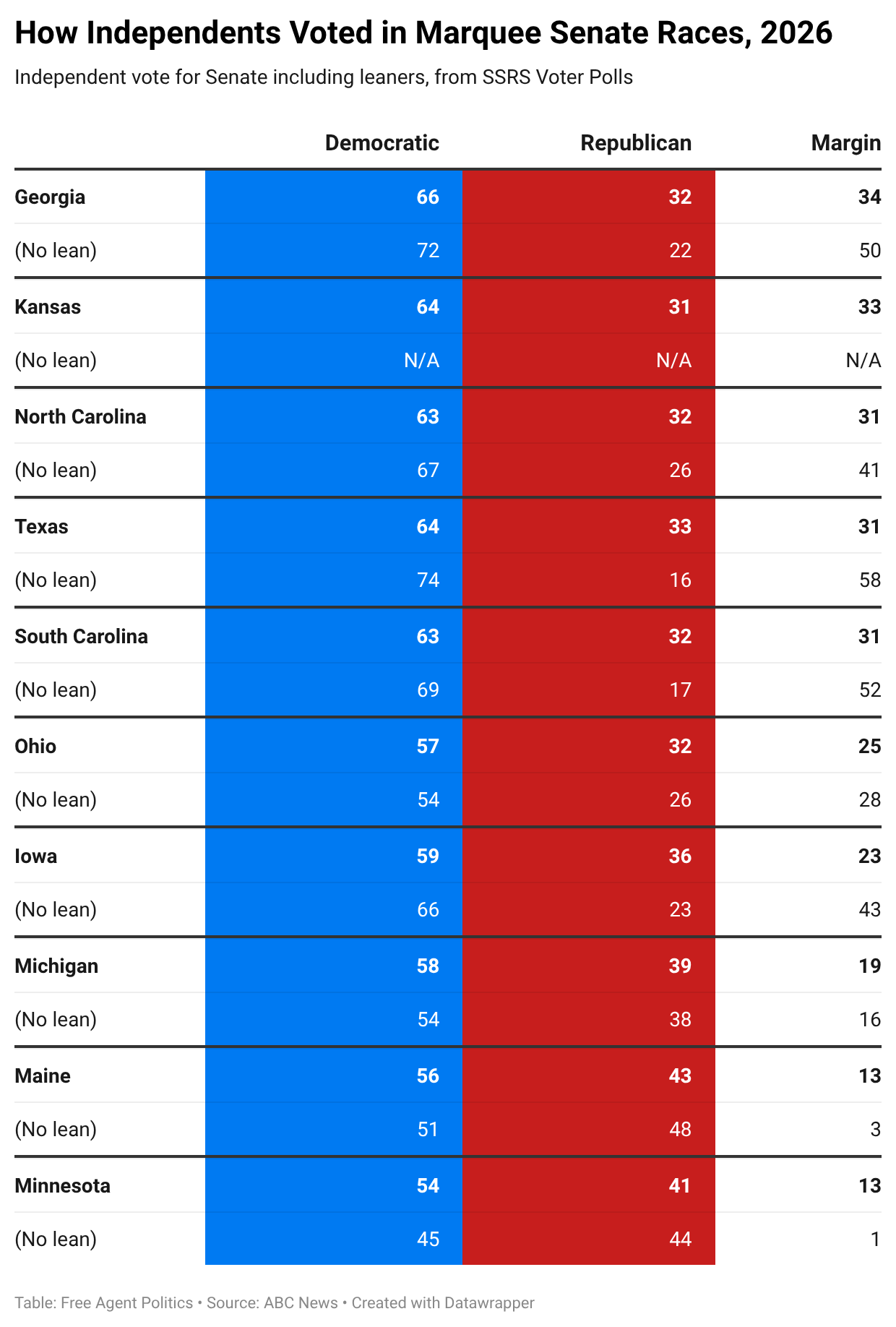
Democrats won a majority of independent voters (including leaners) in all ten of the marquee races highlighted in the table above, with results ranging from 54 percent in Minnesota to 66 percent in Georgia. The Alaska and Mississippi Senate elections are not included here since those results are still outstanding. However, the basic patterns appear similar to these other states in terms of how independents voted.
Although there is no direct national Senate vote measured in the Voter Poll, it is interesting to note that Democratic Senate candidates outperformed the 20-point national House margin among independents in Iowa (+23), Ohio (+25), South Carolina (+31), Texas (+31), North Carolina (+31), Kansas (+33), and Georgia (+34), while underperforming this benchmark with independents in Michigan (+19), Maine (+13), and Minnesota (+13).
In several of these states where true independents are broken out with adequate sample sizes, Democratic margins were even higher—particularly in states like Georgia, South Carolina, and Texas where Democratic margins among true independents reached 50 points or more. In contrast, true independents in states like Maine and Minnesota supported the Democratic candidate by only a 3-point and 1-point margin, respectively.2
Even in states with very different political environments, Democrats attracted all kinds of independents, although the strength of that attraction varied considerably.
For commentators trying to make sense of how or why all of the competitive Senate races broke for Democrats, these results provide a good starting point. Whatever reservations independent voters may have had about participating in the election, those who went to the polls delivered strong numbers for Democratic candidates in Senate races across the country. While Trump and Republicans enjoyed roughly even support among independents in 2024, many of these voters delivered a resounding vote of no confidence in their leadership a mere two years later.
Independents are an ideologically diverse and hard-to-impress lot, mostly focused on inflation and economic matters but also governance and leadership issues. Both Democrats and Republicans will have to prove themselves all over again to these skeptical voters if they hope to win them over in 2028.
The Voter Poll methodology combines pre-election surveys, recontacts with voters, and traditional Election Day polling as described here.
Sample sizes vary in different states for true independents, so the smaller ones like these have more uncertainty and should be read as indicative of the voting patterns, not definitive.
As one of those libertarian-ish independents that find both parties to be a mixed bag that swung to the Dems for the usual reasons, some questions:
1) I see a lot of fretting from the GOP that this is a permanent or at least very sticky shift, largely due to perceived demographic shifts (and immigration/election-stealing BS). My response is that the "between the 40 yard lines" middle and independents could very well swing the other way in two years. Setting aside the usual inertia of the Senate due to its 6-year terms, how likely is this?
I know my vote will be in play. What about others?
2) The GOP pretty much recovered from Watergate in 6 years. Of course, Jimmy Carter was not that strong of a candidate heading into 1980, and they ripped the Nixon Band-Aid off pretty quickly with is resignation and Ford taking the hit for his pardon. What would the expected recovery time of the GOP? Does the clock start now or when Trump leaves office (however that happens)?
I certainly hope the GOP learns its lessons from its time with Trump; I don't see any other choice for the GOP, and I would expect them to remain in the wilderness until they do so.
3) Are there any issues coming to the fore that could permanently weld younger voters (Millennials and younger) to the Dems, much as how the Greatest Generation became loyal Dems, not to mention the 1950-1953 Boomer cohort because of Vietnam/draft/Nixon? Strauss and Howe would say that the Millennials would go as the Greatest Generation did, while GenZ would start out liberal and trend hard conservative as they aged as the Silent Generation did.
4) What does the potential leadership of a post-MAGA GOP look like? Kemp and Youngkin are obvious candidates, with DeSantis, Rubio, and Haley also possible depending on how much daylight they can put between themselves and Trump. I could see Vance becoming persona non grata very quickly; indeed, that might be the only thing stopping a bipartisan impeachment, unless something really weird happens and Vance gets impeached too, and Hakeem Jeffries or his replacement becomes president. The GOP might be willing to accept that if they want to hit fast-forward through the bad parts.
I don't necessarily want the GOP to regain power, but I do want it to be at least viable enough to serve as a check on any excesses from the Dems.
I know it may be horribly premature to ask any of this; however, for its sake I hope the GOP is already thinking about all of this.
Independent here, no lean, used to be far-Left Liberal type...somehow this election leaves me rather distressed and worried. I get that everyone voted AGAINST the Trump administration policies, which is roundly deserved, and not especially FOR Democrat policies. And yet...the Dems have not changed at all, everything independents (and others) dislike about therm is still in play. After this election, Dems are already tripling down on their insane policies, plus we now have the further craziness of the DSA and these Muslim politicians to deal with.
This bothers me. Hard to believe voters in these numbers support the kind of things Democrats are pushing. If not, then we'd better pull ourselves together and let them know that they are no more acceptable to the general public than the Trump administration is. Something is really going wrong here, and this election has only highlighted it for me, not made me feel like a decent change is in the wind.