


The 2026 midterms mark the fifth consecutive election in which Republicans lost the overall independent vote, according to past exit polls and the new Voter Poll (which combines in-person exit polling with a pre-election survey to better account for early and absentee voters) conducted by SSRS.
During that time, Republicans were able to win key elections despite these deficits, taking control of the House in 2022 and the Senate and presidency in 2024. The key to both of those victories for Republicans was keeping the independent vote relatively close to an even split—an important achievement given that this group constitutes roughly one third or more of the electorate, comparable to, and sometimes larger than, the share identifying with either major party.
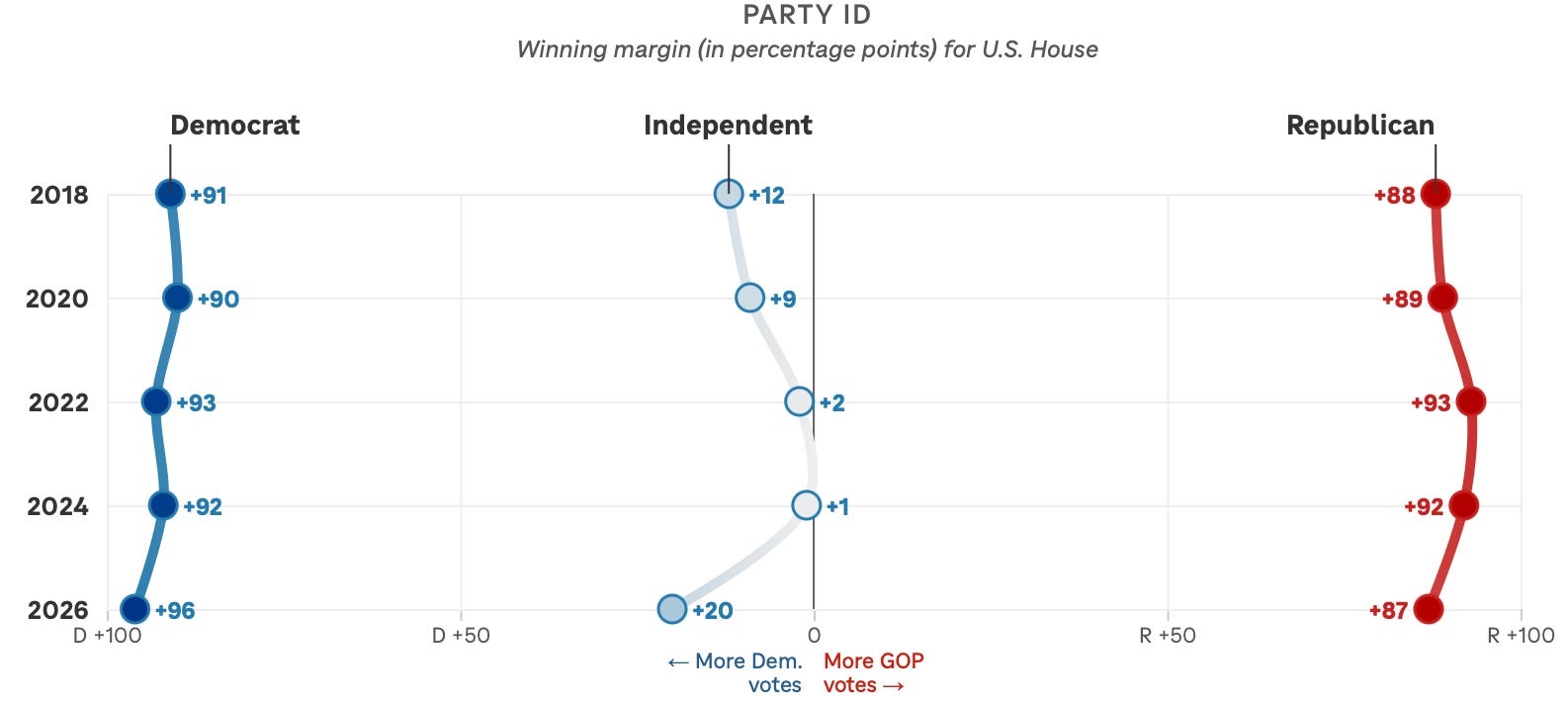
As seen in the chart above, however, 2026 saw independents break for House Democrats by an overwhelming 20-point margin in preliminary Voter Poll estimates, and even larger margins in several of the key Senate races won or held by Democrats as my column earlier this week highlighted and broken out below.
Democratic margins among independents in key Senate races:
Jon Ossoff, Georgia (+34)
Adam Hamilton, Kansas (+33)
Roy Cooper, North Carolina (+31)
James Talarico, Texas (+31)
Annie Andrews, South Carolina (+31)
Scott Colom, Mississippi (+28)
Sherrod Brown, Ohio (+25)
Josh Turek, Iowa (+23)
Abdul El-Sayed, Michigan (+19)
Troy Jackson, Maine (+13)
Peggy Flanagan, Minnesota (+13)
As David Winston notes, the size of the Democrats’ advantage with independents put numerous House districts and Senate seats in play this cycle, many of which Trump and Republicans won by double-digits in 2024. And the economy and inflation overwhelmingly drove the voting behavior of these independents against the incumbents:
According to the exit polls, the independent vote, not surprisingly, was largely driven by the economy, their top issue concern. Much to the detriment of Trump and the Republicans, 79 percent of independents thought the economy was not good/poor, versus 21 percent who thought the economy was excellent/good. In terms of inflation, 82 percent said it had been a severe or moderate hardship for them, and 89 percent said the cost of living was a crucial or major factor in how they voted for Congress.
The president and his party got the blame. Looking at specific policies, 70 percent of independents thought that Trump’s tariff policies had hurt the national economy, and more broadly, 72 percent said his policies had worsened economic conditions in the country. As a result, Trump’s overall job approval among these voters was 30 percent approve with 70 disapproving; 59 percent strongly disapproving. These extraordinarily bad numbers topped even Biden’s worst job approval numbers.
Trump’s decision to ask voters to “pretend I’m on the ballot,” was, in retrospect, a strategic miscalculation. It was a mistake to tell voters that the economy was in great shape when it was clear the majority of people were very unhappy when it came to inflation—the rising cost of gas and groceries.
President Joe Biden and his administration made the same mistake as President Trump on the economy, telling voters that the economy was doing great as inflation reached its highest level in four decades. Notably, both party leaders and their congressional allies suffered greatly among independents for misreading or ignoring their concerns.
Going into the 2028 presidential election cycle, both parties would be well advised to heed the message independents are sending to their elected officials about the economy and other issues. These voters are not in the pocket of either party—and how they break ultimately will determine the election.
Less than two weeks after the midterms, you can already see the two parties teeing up mistakes and fueling a new round of disgruntlement. Independents aren’t going to like the massive tax and spending proposals—or some of the more ambitious plans for expanding government-run health care—that Democrats are mulling, and they certainly won’t like two more years of Trump being Trump on the economy, immigration, the war in Iran, and general leadership issues.
Whichever side figures out how to rein in its extremes first will probably be best positioned to win a decisive share of independent votes in 2028. Fortunately, we don’t have to deal with that for a while as voters can take a well-deserved break from politics.
I see independents being in charge as a good thing.
The politicians almost always vote in a block. When you elect them you're voting for the whole party platform although you may disagree with 20-40% of what that means.
The real power brokers are the 10-15 in Congress that often don't follow the party 100%. The rest are a rubber stamp.
Not sure there is really such a thing as “independent” except in name. Very few voters agree with every, and maybe not even most, of their nominal party’s positions on every issue - no doubt there are pro-lifers who support Medicare for All, people who oppose tariffs but support continuing aid to Israel, etc and etc.
The interesting thing about how “independents” broke in the Senate races is that moderate candidates did considerably better with them than progressives.
Maybe “independents” are more accurately characterized as a fraction of the unreliable, mixed-views centrists who also make up the majority of people who identify with both parties and are despised and ignored by party activists and true believers.