


American politics operates on a reliable chestnut: as go independent voters, so goes a president’s standing and his party’s electoral chances. For President Trump, like Joe Biden before him, things are not going well with this critical bloc of voters.
AP-NORC analyzed nearly 5000 “strict independents” (those who do not identify with or lean to one party or the other) from 21 different survey waves to examine how Trump has performed from the election period into April of this year. As seen in the chart below, highlighting his standing in five different waves, support for Trump among independents has declined 17 points,1 from 43 percent during the pre-presidency period to 26 percent by the end of April 2026. In contrast, support among fellow Republicans has dropped marginally while already low support among Democrats has remained stable.
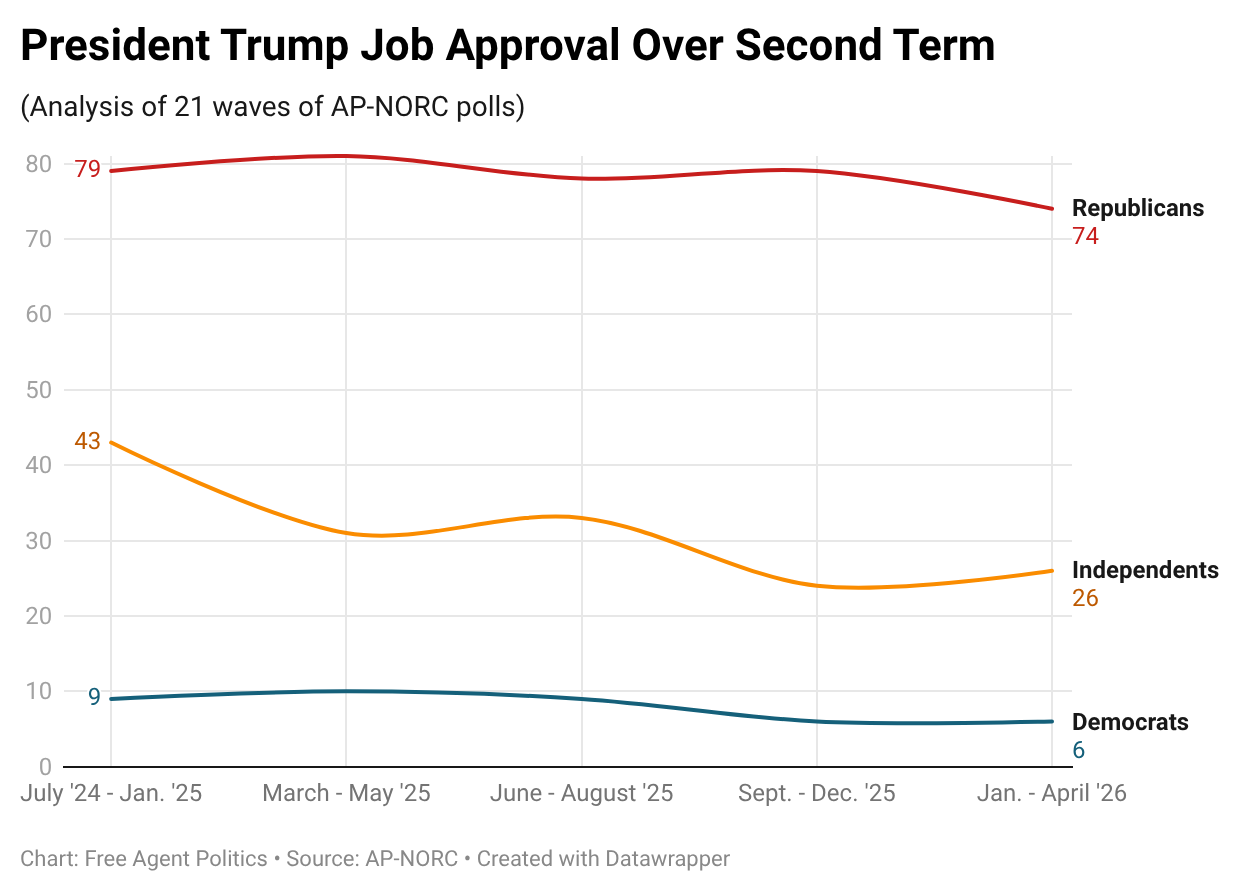
This examination of strict independents is telling since, in contemporary polarized politics, one would expect partisans and partisan leaners to approve or disapprove of a sitting president regardless of what he actually does. Pure independents, by contrast, have weaker or nonexistent partisan attachments and thus may be more likely to judge a president based on what he is doing in office and his performance on their most important concerns.
Notably, AP-NORC reports that the president’s support among non-college-educated independents has fallen more precipitously than it has among college-educated ones, “dropping from 48 percent during the election and pre-presidency period to 27 percent during the Iran War period. College-educated independents showed less volatility, starting at 29 percent support during the election and shifting to 24 percent during the Iran War period.” Trump’s support has fallen across all racial and ethnic groups, with sharper declines among black and Hispanic independents. Support has also dropped among independents younger than 60, yet remained stable among those independents 60 and older.
On multiple fronts, from the economy to foreign policy, Trump is not performing well in the eyes of most independents. The overall economy and cost of living, however, are major concerns for these disenchanted independents. As the AP write-up on the polling states:
About half of independents who supported Trump in 2024 said inflation was the single most important factor for their vote, AP VoteCast found, and most expressed high levels of concern about the cost of food and gas.
More than a year into Trump’s second term, inflation remains high, fueled by gas prices that remain elevated as the Iran war continues. An AP-NORC poll conducted in April found that about 3 in 10 independents were “extremely” or “very” concerned about being able to afford groceries in the last few months, and a similar share were worried about being able to afford gas.
The analysis found that Americans’ views of the U.S. economy tend to align with their view of the president. Those with negative views of the country’s economy tended to have negative views of Trump, and about 8 in 10 independents described the U.S. economy this spring as poor.
The latest AP-NORC polling from May found that only about 3 in 10 independents approve of how Trump is handling the economy, in line with the roughly 3 in 10 who said that at the beginning of his second term. The April poll found only about 1 in 10 independents—12 percent—approved of how Trump was handling the cost of living.
What will this low approval of President Trump among independents mean for the 2026 midterms? There are still two more months of campaigning to go before the election, but the latest survey evidence from YouGov shows a substantial Democratic lead among the broader group of independents. Although not directly comparable to the pool of strict independents examined by AP-NORC (they did not provide generic ballot information), the YouGov data show that independents broadly would vote for the Democratic candidate for Congress over the Republican candidate by a 43 percent to 24 percent margin, with roughly one third of independents still unsure or not choosing either major-party candidate.
There are myriad factors that go into determining the outcome of an election, and Republicans still hold many cards in terms of their own voters and geographical strengths. But the incumbent party can ill afford to discount independents’ displeasure with the performance of their president if they want to hold one or both chambers of Congress in November.
The questions used by AP-NORC include the pre-election framing and general job approval measure after he took office: “[Donald Trump] For each of the following, please indicate if you have an unfavorable or favorable impression,” and “Overall, do you approve or disapprove of the way Donald Trump is handling his job as president?”
The fact that Trump has been behaving like a serious lunatic for much of his second term is the ONLY reason the increasingly radical Democratic party has any chance at all. He has been their saving grace. I have no doubt that middle of the road voters are horrified and sickened by Trump's daily antics. I know I am. And I will never vote Democrat again. But many will.
When considering the overwhelming negative coverage of Trump’s and his second term, it is amazing the president isn’t even more under water. From ChatGPT “ABC + CBS + NBC: 7.8% positive / 92.2% negative, or net –84.4 points toward Trump, for Jan. 20–Apr. 9, 2025..”.