


In an age of near-permanent dissatisfaction with the two major parties, it is misleading to say that either Democrats or Republicans are “winning” independents, even when one party wins most of their votes in a given election.
Yes, political independents on average tend to move in one direction and increasingly determine the outcome of national elections—the classic swing vote. According to validated voter data from Pew, independents slightly favored Trump in 2016 and split evenly in 2024, helping him to win the Electoral College both times and the national popular vote in 2024. In contrast, independents broke heavily for Biden in 2020, giving him solid majorities in both the EC and popular vote.
Looking at the 2026 midterms, pre-election polling strongly indicates that independents will again move in the opposite direction to offer more of their support on average for congressional Democrats over Republicans. Take all polling these days with a pinch of salt, but it’s not a stretch to see why independents are moving against Republicans given their disappointment with President Trump’s handling of the overall economy, cost-of-living issues, gas prices, and other policy choices like the Iran war.
An interesting new independent public opinion research firm, Centerline Research & Strategy, run by veteran political analyst Natalie Jackson, finds independents (including those who lean to one party or the other) favoring a Democratic congressional candidate over a Republican one in their district by a 48 percent to 31 percent margin, with 20 percent still undecided. The margin in favor of congressional Democrats is even higher, 52 percent to 23 percent, among the so-called “double haters,” those voters who hold unfavorable opinions of both political parties.
Independents are voting Democratic to express their displeasure with incumbent Republicans, not because Democrats have won them over.
Majorities of independents in this study rate both Democrats and Republicans unfavorably, with the incumbent party receiving slightly lower overall favorability from independents than the opposition (33 percent of independents are favorable toward Republicans; 42 percent toward Democrats). Many independents therefore appear to be holding their noses when telling pollsters they intend to vote for Democrats this November.
Likewise, among the “double haters” most likely to vote this fall, less than three in ten expect their lives will improve after the upcoming congressional elections and around one quarter expect their lives to get worse.
Perhaps more telling, independents and “double haters” express the most intense anti-incumbent sentiments of all voters. As seen in the chart below, roughly three quarters of true independents and those unfavorable to both parties agree that “most representatives in the U.S. Congress should be replaced with someone new.”
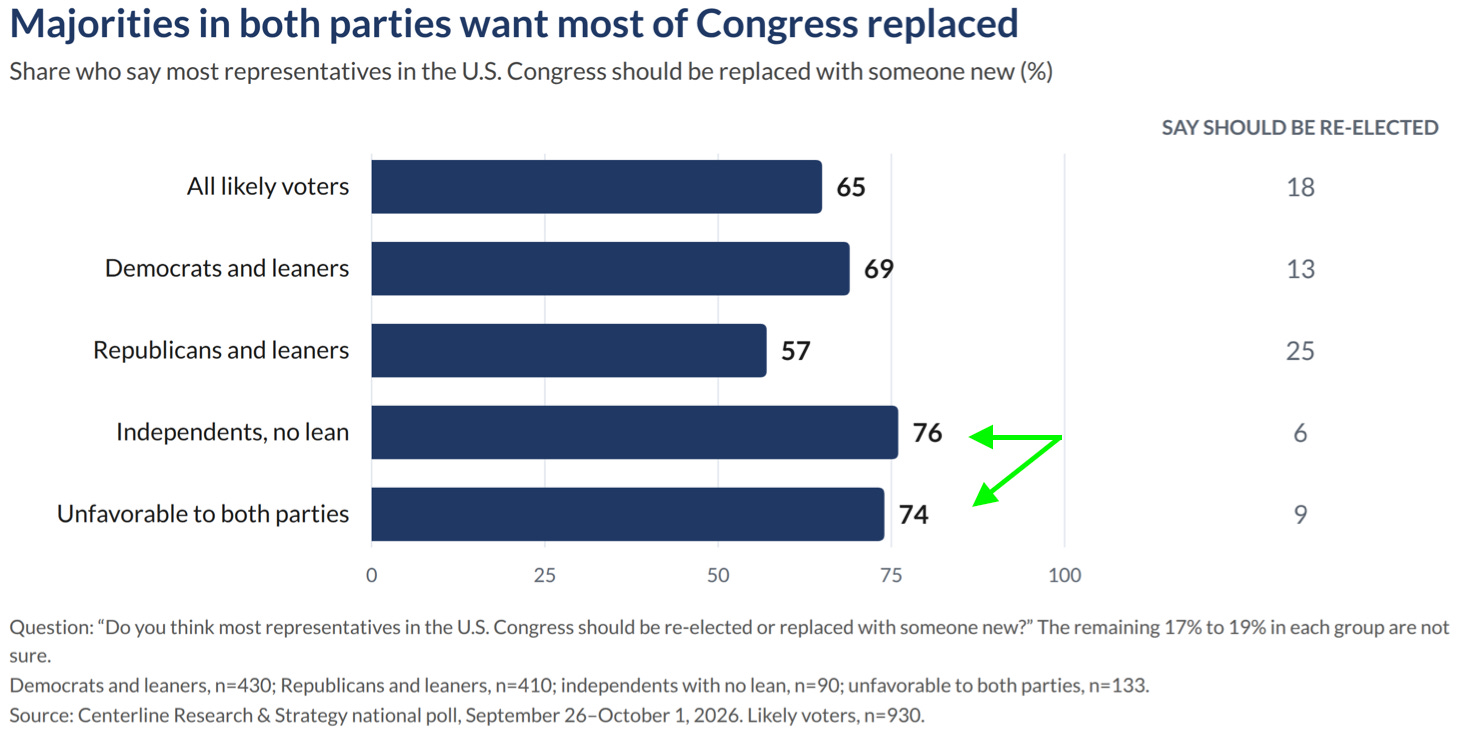
Overall, less than one fifth of all likely voters believe that most members of Congress should be re-elected compared to almost two-thirds who think they should be replaced with someone new—powerful anti-incumbent sentiment across the electorate, even as some of this is obviously partisans not wanting to re-elect members of the opposite party.
In the bigger picture, it’s clear that neither party has a firm hold on independent Americans. Republicans in power are again learning this lesson the hard way. Yet Democrats should not delude themselves into thinking the anti-incumbency voting behavior of political free agents in 2026 represents a realignment of these voters away from Republicans and into their arms.
The 2026 midterms will likely tell us a lot about how independents feel about Republicans in a second Trump term. They will tell us very little about whether these independents are primed to become Democratic converts.
Independents, particularly those without a leaning, are serious about not liking either party and their votes will remain up for grabs, especially in the first post-Trump presidential election in 2028.
I agree as a politically homeless double hater. The 2026 midterms will not be a forecast of the 2028 presidential election. Just like Trump blew up his second term, congressional Democrats, especially if they win both House and Senate, will overplay their hand and be back in the doghouse. Trump will still be unpopular so the Republicans also should not expect 2028 miracles.