


“Which side are you on?”
For more than a decade now, the two political parties have defined their visions and agendas for Americans along strictly sectarian lines. You are either with us, the Democrats, the forces of democracy, or you’re with them, the fascists and authoritarians. Conversely, you are either with me, Donald Trump, the only man capable of “Making America Great Again,” or you’re with them, the communists and the elites.
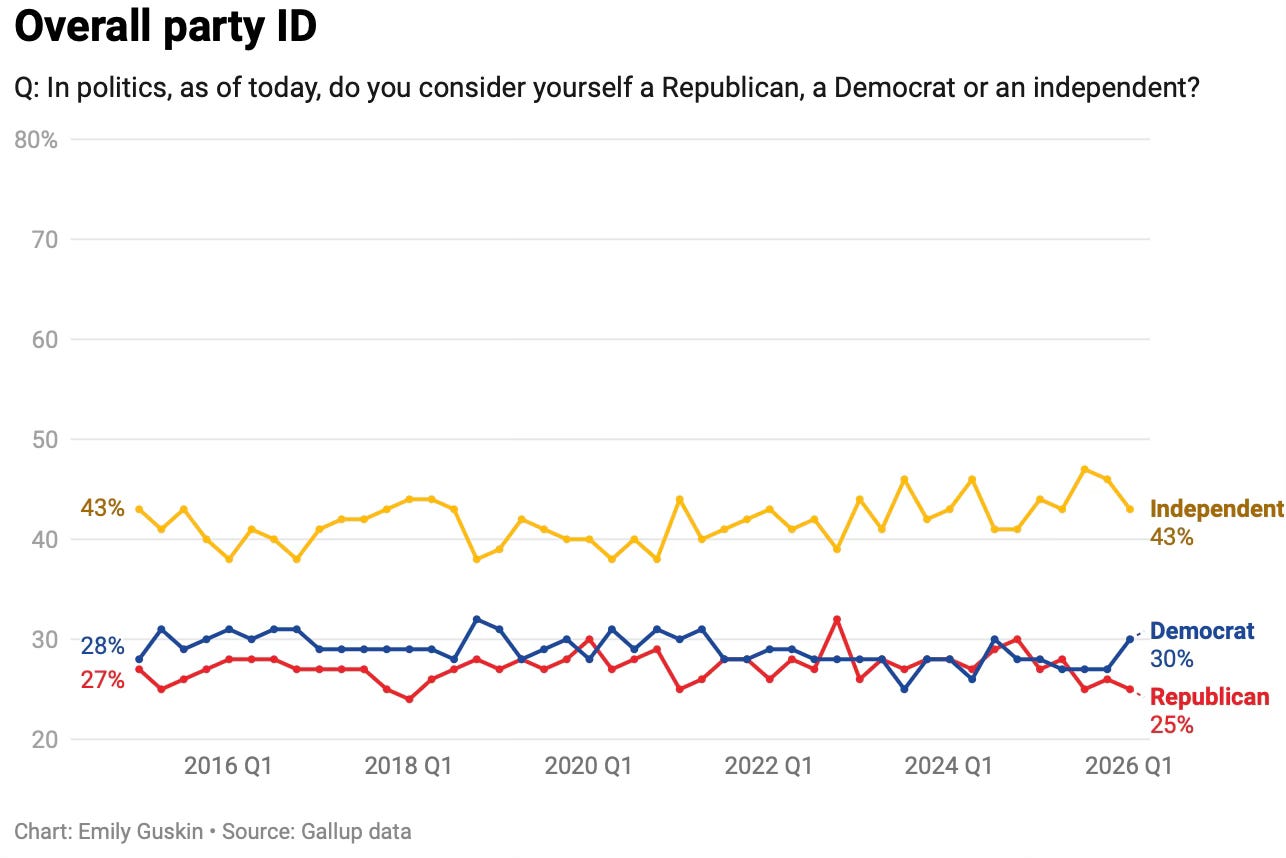
Millions of Americans—the more than 40 percent who currently do not identify with either party—roll their eyes at this partisan hyperbole. Political independents, despite vast differences in their values, views, and preferred policies, share one common trait: they reject binary politics. It is the one thing that holds them together: “I will not join either of your teams, and I don’t agree to the skewed rules of your political game.”
Binary thinking and team support have their place. Moral relativism, for example, is harmful to society and undermines social order. There isn’t a “kind of good” form of murder, assault, or purse snatching. It’s all wrong and should be punished. Facts are also true and can be proven. The earth is round. Water is made of hydrogen and oxygen. There are two biological sexes, male and female. The United States is made up of 50 individual states plus a federal district and five inhabited territories.
Likewise, affinity with one’s team is both natural and beneficial for humans. Parents favor their children and families over others out of love and the desire to protect them. People take pride in their cities, towns, and neighborhoods. Real sports fans don their colors and root for their teams through thick and thin despite minimal likelihood of making the playoffs (Go Orioles!).
Unlike these positive psychological and factual divides, political binaries are mostly unhelpful to the country. The categories are familiar to anyone who follows politics. Democrats versus Republicans. Blue states versus red states. Our team is good. Your team is bad. Our faction is righteous and has the correct policies. Your faction is wicked and corrupt.
In politics, this split between the two main teams—and within each one in terms of ideological or personality-driven divides—produces enormous social and psychological pressures on members to conform to ideas that are often wrongheaded, misguided, or outright false. Calling out the obvious flaws on your team (”That’s a dumb idea.” or “He’s lying to you.”) often brings opprobrium and ostracism by the team enforcers—party officials, affiliated media properties, and voters themselves on social media.
For independents, neither political party has a valid claim on the truth, the best leadership, or the best policies for America. Look no further than the red-hot issues of inflation and “affordability.” Biden and Democrats claimed they were addressing high prices with their “Inflation Reduction Act,” which was mainly a climate change and health care bill that did little to bring down inflation. Similarly, Trump and Republicans claimed prices would come down when they gained power, and since then, tariffs, massive tax cuts, and new wars have done little to improve the situation or public sentiment.
Independents were mad about Biden’s deceptions on inflation and prices, and now they are mad about Trump’s.
Independents choose a way out
To escape this torture, independents consciously reject binary team politics and the rigid terms of membership dictated by contemporary Democrats and Republicans. Independents don't vote “Blue no matter who,” and they don’t believe in Reagan’s “Eleventh Commandment,” famously declaring, “Thou shall not speak ill of any fellow Republican.”
On the policy front, independents refuse to accept that there is one party line for dealing with America’s economic and social challenges, and they remain open to ideas from across the ideological spectrum or outside of it altogether.
Some independents are traditional center-left to center-right voters who favor moderation and bipartisan cooperation along with sound economics, deficit reduction, and prudent spending. Some independents are more populist and anti-status quo oriented and desire serious political reforms to shake up the system along with policy interventions to check the power of the wealthy and help the working class. Some independents hold a mix of views that are not represented fully by binary parties or ideologies—think of Americans who may be economically progressive but culturally conservative. And some independents are just checked out and uninterested in any one perspective or the promises of the two parties and their candidates.
Independents and upcoming elections
Independents are forced every election cycle to make choices about one party or the other, or not to vote at all, because the system is designed to exclude or hold down outside voices and third parties and protect the interests of Democrats and Republicans.
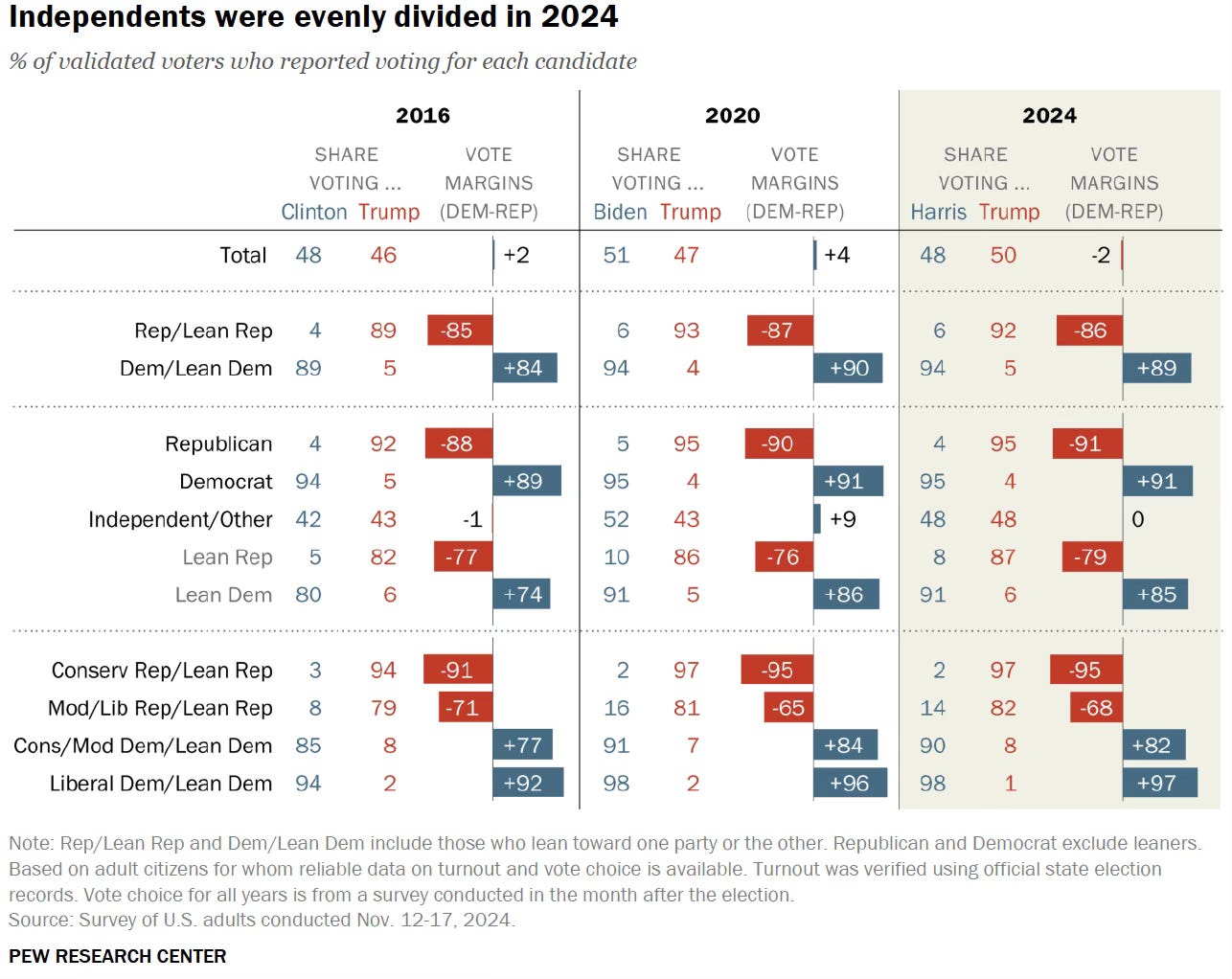
Therefore, in practice, and despite their divergent viewpoints, independents often gravitate towards one party or a particular candidate in an election cycle given the specific conditions of the country and the fixed legal rules of two-party politics. The movement (or non-movement) of the independent bloc has profound consequences in narrowly decided national elections. As seen in the Pew data below, a majority of independents (including those who lean toward one party or the other) backed Joe Biden in 2020, helping to secure his election as president. In contrast, independents were basically split in both the 2016 and 2024 elections, helping to give Donald Trump two victories.
With the 2026 midterms fast approaching, it appears likely that independents will break heavily against the incumbent Republicans given the party’s inability to address their signature concerns about inflation and high living expenses. President Trump’s net job approval rating has declined nearly 50 points among independents since the start of his second term, an inauspicious position for holding his party’s congressional majorities.
Even if independents help Democrats achieve divided government in the November elections, they are far from certain to favor the party heading into the first post-Trump election in 2028.
Independents aren’t on anyone’s team.
Free Agent Politics plans to follow all of these developments with independents over the next two years. Thanks again for checking out the new publication, and please let me know your thoughts in the comments or on Notes.
I was surprised to see this in my inbox, but I'm glad I gave it a read-through. I've been a conservative independent for the majority of my adult life, though since 2016 the boundaries shifted so I am more centrist now even though I didn't really move closer to the center so much as the extremes pulled farther away, leaving me closer to the center by default. Even so, I recognize that politics is about compromise (not compromising beliefs, but making adjustments where possible in order to reach a place of agreement with someone who has different ideas on how government should work), and that someone with different ideas or beliefs is not automatically my enemy. As a nation we used to be better at this, but we also have been worse. Maybe it's suitably ironic that a self-proclaimed independent longs for people to work together.
I vote for the candidate that would best represent my district or state. However, politicians from both party appear to be under more pressure than in the past to vote as a block instead of the best interests of their constituents. Starting in 2000, I feel that the Democrat party has strayed further than the Republicans on what’s best for their constituents and instead, has tried to appease all their activists (open borders, defund the police, gender affirming care, DEI, socialism). I am happy they are backtracking on some of these policies, but it shows poor judgement that they ever adopted these views in the first place. I still try to vote for the best candidate but it is becoming harder for me to vote for Democrats at the national level.
I am so happy you and Ruy are back!