


Although political independents, broadly defined, constitute the largest segment of the electorate according to many surveys, there remains a great deal of uncertainty about their precise demographic and ideological profile.
However, in May of this year, three academic researchers released an interesting new study on the contours and make-up of this increasingly important population that provides more concrete insights. In their report entitled “Who Are Independents? Are They Moderates?” Eveline Dowling, Nathan Micatka, and Caroline Tolbert used administrative voter-file data and modeled political and demographic information from Catalist complemented with a large national survey to learn more about independents. This methodology differs from traditional survey research alone, where people are typically asked if they consider themselves a Republican, Democrat, or independent with follow-up questions to see if independents lean one way or another or not at all.1
The researchers drew random one percent samples from Catalist voter files in 2020, 2022, and 2023 to explore the composition of voters classified as independents using the modeled data and then compared them with the overall U.S. population. As seen in the table below, showing the 2023 sample, they discovered that independents are overwhelmingly moderate.
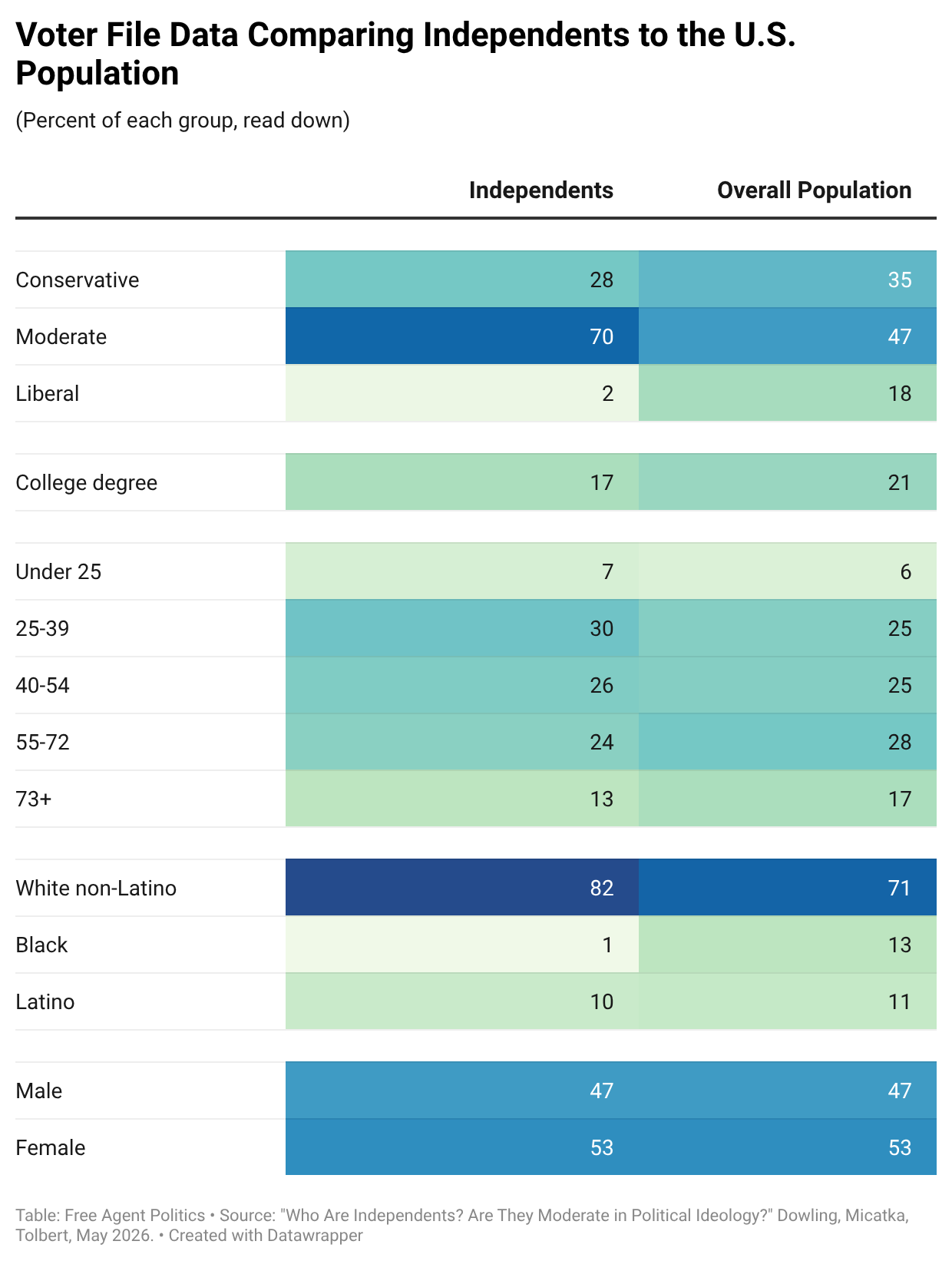
Seventy percent of independents in this 2023 voter-file sample are classified as moderate, compared with just under half of the overall population. The percentages were even higher for the 2020 and 2022 samples, both showing more than 90 percent of independents classified as moderate. These data show that independents tend to be younger and less educated than U.S. adults more broadly. Independents are also more likely to be non-Latino white and less likely to be black than the overall population, while Latino representation is about the same. But there are no meaningful gender differences in the composition of independents.
This core finding is notable given other studies relying solely on self-reported party identification in survey data that directionally show independents being more moderate but at lower levels than those seen above. Pew Research, for example, released a nice report in 2019 on independents highlighting, “As in the past, more independents describe their political views as moderate (43 percent) than conservative (29 percent) or liberal (24 percent). These shares have changed little in recent years.”
The three researchers then dove into the 19,000+ respondents in the Collaborative Midterm Survey (CMS), funded by the National Science Foundation, to learn more about the views of political independents. Breaking out independents into those who lean toward Democrats or Republicans, excluding “true” independents who don’t lean either way due to low sample size, the researchers discovered that independents themselves are more likely than partisans to believe that independents:2
Are more willing to work across party lines;
Are less emotional about politics;
Are more willing to consider opposing viewpoints; and
Do not believe one should have to choose a party to vote in America.
This study therefore suggests that moderation among independents involves more than simply holding centrist positions on key economic, social, and national security policies.
Although there may be some alignment on specific centrist policies—something that I will explore in future posts—this new research indicates that independents place a premium on flexibility in politics, consideration of opposing viewpoints, a desire for cross-partisan cooperation, more political choices, and less rigid partisanship in general. Moderation, in this sense, offers a distinct political identity and framework for better understanding who these independent voters actually are and what they believe.
The researchers wrote this about the limitations of their methodology: “First, registration-based independents in the voter file data and survey self-identified independents are not fully interchangeable measures; voter file measures reflect a formal administrative decision, while survey-based measures capture psychological identification. These two populations may differ in meaningful ways, such as strength of partisan affect or likelihood of being an “undercover partisan.” Second, the ideology plus score used in the voter file analysis is a model-based, vendor measure derived from commercial and administrative data inputs. Given this, the findings may be sensitive to the assumptions underlying the Catalist model and the 40-60 cutoff used to define ideological moderates in our analysis. Finally, the perception items analyzed are limited to those available in the 2022 CMS. While these items map onto the identity and social dimensions central to our theoretical framework, other relevant dimensions—including political trust, efficacy, political knowledge, and preference for institutional reforms—are not captured, representing productive avenues for future research.”
Question wording: “Below are statements that have been used to describe independents that are not affiliated with either of the two major political parties in the U.S. (Democrats and Republicans). Check any of the following box(es) that you agree with. Independents…”
As an Independent, my problem with parties is that they pick a position for you, and you don’t have a voice. They also demonize the other party, some of whom are my friends. For me, party loyalties are like the old saying about churches “pray, pay and obey” without the prayer part. Anyway, I think in-depth interviews more than surveys could lead to some helpful information.
This is informative and not overly surprising. Most Americans assume, most of us, regardless of label, Party registration, or the lack thereof, are moderate. Now please tell us, where we find politicians with the same leanings?
For example, consider the Open Border. Many Texans, Dem or Rep, regularly attend church. Texas Churches noticed the Open Border first. They requested donations for migrants, before anyone else in the US really mentioned the issue. They needed clothing, toys, linens. . .
At the beginning, it was assumed by Texans of both Parties, cleaning out their closets or hitting the Dillards clearance racks for donations, the situation was temporary. No one could imagine, either political Party would allow it to continue.
As the flow at the Border not only continued, but picked up steam, it eventually became national news. Yet only 1 or 2 Dem politicians would even admit it was a problem, let alone demand its' end. That went on for 3.5 years, until pollsters informed Dems, the Border would be their political Waterloo. Suddenly a few Dem pols were slightly concerned, and eventually the sea of humanity slowed.
On the Right, many would note the Iran War is something few moderates support, especially 6 months in. Yet no one seems overly concerned, once again, major US policy might not reflect the will of the vast majority of the American people.
So if the majority of Americans are moderate, but the neither Party is moderate, where does a voter turn? Or is every US election now doomed to be a Sophie's Choice, with the only options, bad and worse.