


It’s a running joke in many societies just how bad and embarrassing contemporary politicians are these days. Shameless, pandering, inept, and vain fools selling electorates policy fantasies and party propaganda.
As with any good joke, it only works because the underlying premise is basically correct.
Ipsos just released its Global Trustworthiness Index for 2026, including more than 23,000 interviews across 31 countries, and, lo and behold, “politicians” emerge as the most untrustworthy group among all professions on average and the single most distrusted group in 19 of the nations surveyed, followed closely by “social media influencers” and “government ministers” in several countries. Politicians are seen as untrustworthy by two-thirds or more of the populations in Argentina, Belgium, Brazil, Chile, Colombia, France, Germany, Great Britain, Peru, Poland, Romania, South Africa, Spain, and the United States.
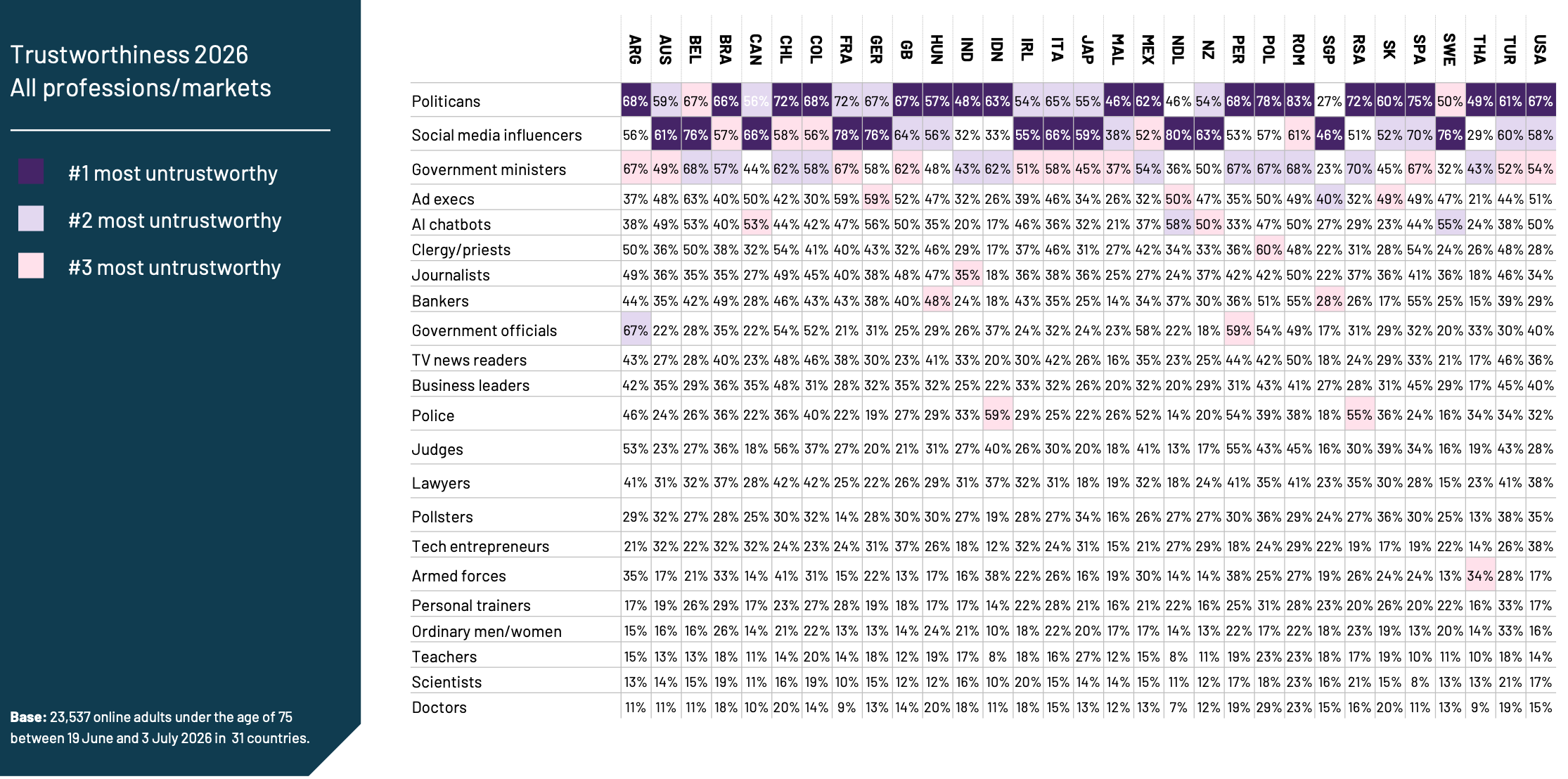
In contrast, “doctors” come out on top as the most trustworthy professionals overall and land in first place in 16 of the 31 nations, followed closely by “scientists” among all countries. “Teachers” also receive high marks for trustworthiness in many countries.
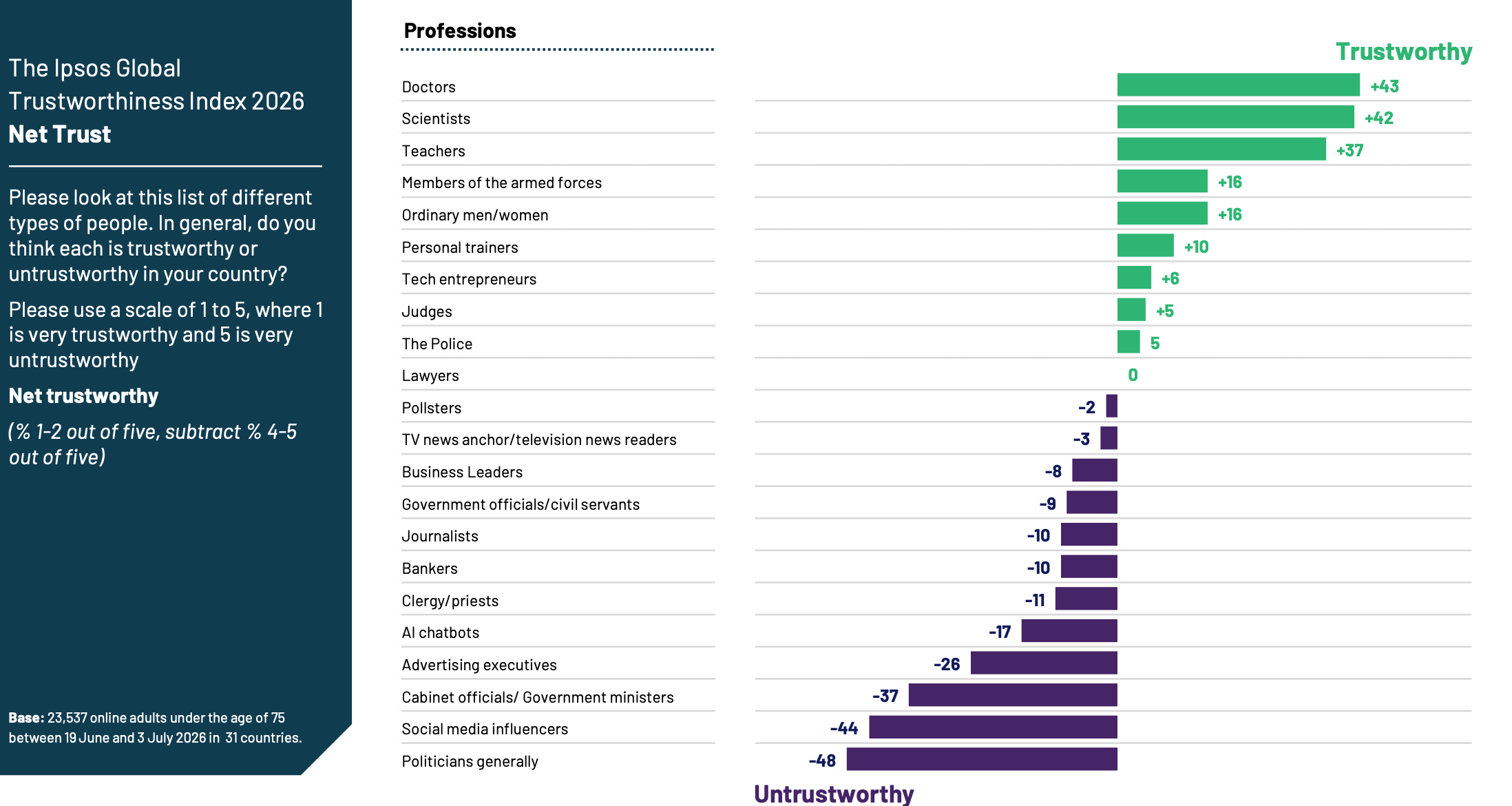
As the table below highlights, doctors are viewed as more trustworthy than untrustworthy by a 43-point net margin across all countries and scientists by a 42-point margin. Looking at the bottom of the chart, politicians receive a -48-point net trustworthiness rating, with social media influencers at -44 and cabinet officials and government ministers at -37 on net.
Besides yielding a hearty guffaw about the foibles of the political class, what do these data tell us about professions more generally and politicians specifically? The answer, I believe, is not that doctors and scientists are intrinsically better or wiser people than everyone else. It’s that their professions are designed to create high-functioning members and yield work that is linked to outcomes with clear processes for uncovering and fixing mistakes.
First, the most trusted professionals globally, like doctors and scientists, work in fields that require substantial amounts of knowledge mastery and credentialing before these workers are given any real responsibilities on the job with patients or in the lab. One can’t just announce they are a doctor or a scientist without first proving an understanding of the core concepts, practices, and technical aspects of these professions.
Second, there are serious professional norms and accountability measures for doctors and scientists that far exceed those in other fields. There’s a reason doctors’ medical liability insurance is so costly in many places—if doctors make a mistake at work that seriously harms a patient or perhaps causes their death, they are on the legal hook for their actions. Doctors want to perform admirably not just for these legal concerns, but also for ethical and professional reasons (e.g., The Hippocratic Oath). Physicians want to help people recover from illnesses and injuries to the best of their abilities and through the use of modern medical technology. Scientists may not face as many immediate life-and-death situations, but their work is also subjected to rigorous peer review, oversight, criticism, and replication to identify mistakes and improve the reliability of empirical findings and applications.
Third, and perhaps more nuanced, doctors and scientists generally need to be able to acknowledge mistakes, errors, and oversights and make corrections when problems arise. Doctors and scientists aren’t inherently superior people, but a dose of intellectual and professional humility helps to ensure that both their personal work and their overall fields are successful. Smart, credentialed people make mistakes just like the rest of us. The difference with these more trusted professional fields is that medicine and science both require mistakes and errors to be honestly reported and acknowledged. New, correct information is then incorporated into future work to ensure its success, whether it involves a blood treatment or the development of a new building material or industrial chemical.
The field of politics as practiced today is not at all like these most trusted professions in each of the three areas. In some cases, the lack of formal professionalism is beneficial. One doesn’t necessarily need elaborate credentials and degrees to represent constituents and vote on public policy. In fact, many of these elite signals might inhibit politicians from seeing potential new avenues for policy work or lead them to miss economic or social developments that may be affecting their constituents in negative ways. However, it doesn’t help the country at all when politicians have no idea what they are talking about—on the economy, on national security, on regulation—and cast votes on policies they don’t understand and legislation they probably haven’t even read.
The area of norms and accountability is also seriously lacking in contemporary politics. Job incentives for politicians do not always align with the best interests of voters or the creation of effective public policies that spend the taxpayer’s money wisely. Instead, politicians mainly seek to enhance their profiles and increase media attention, raise money from donors and activists, and secure positions of power from which to dispense goodies to fellow partisans and punish opponents.
Likewise, most politicians do not suffer personally or professionally for lying, misrepresenting facts, twisting evidence, and putting their thumbs on the scale for particular outcomes. In contrast, doctors and scientists who engage in serious misconduct can suffer substantial reputational or legal consequences and possibly be drummed out of their professions altogether. Subsequently, our governing institutions suffer from inconsistently applied accountability measures that sever the policy-making and executive decision-making processes of politicians from measurable goals and policy outcomes. The two parties and their leaders basically do whatever they want—whether it works or not—without any real fear of consequences or reprisals.
Finally, politicians, unlike other trusted professionals, almost never admit errors or mistakes, and few, if any, ever try to improve their work on a consistent basis. If a political leader and his party pursue economic policies that blow up the deficit and fuel inflation, most don’t seem to care and just blame the other side for the situation. When politicians draft legislation full of perverse incentives and unintended consequences, their attitude is to let the courts and the bureaucrats handle the mess, not to clean it up and make it work.
The main difference between trustworthy professions like medicine and untrustworthy ones like politics is that the former field has developed and inculcated serious standards of excellence, personal rectitude, and accountability for its members, while the latter rewards the biggest grandstanders, buffoons, and attention seekers who can’t be bothered to sweat the details on good policy and outcomes.
If politicians want to get off the bottom of the trustworthiness chart, they will need to up their game and take some cues from doctors and scientists about how best to organize their profession.
Although it probably sounds crusty and old-fashioned at this point, the political field could definitely use more overall professionalism, wider recruitment of people with substantive knowledge of industry and technology, ongoing skills training and education about complex national issues, and much higher standards for elected officials, civil servants, and government appointments.
Democracy shouldn’t be turned over entirely to the experts. The lesson is not that elected officials require more education or elite stamps of approval. Rather, it’s that the two parties and the legislative and executive branches need stronger institutions and norms. Government agencies and public officials themselves should want to create the strongest framework possible for training members and staff to evaluate and solve difficult public policy questions facing the country, encourage more nonpartisan analysis of critical issues, establish clear consequences for corruption and malfeasance by members, and implement effective mechanisms for evaluating policies and adjusting them so they work correctly.
If politicians want more people to trust them, they need to perform their jobs in ways worthy of the public’s respect. Just as the doctor ordered.
Unlike medicine and science, politics is a direct reflection / distillation of human nature. The same tactics that work in the field of medicine will not make politicians trustworthy. If we really want to clean up politics, we need to take a hard look at political parties, what they do and how they operate - and then either change or eliminate them. The parties, for the most part, represent the worst elements of human nature (greed, self-interest, the lust for power, ends justify means, duplicity). To say that they are a necessary evil is a cop-out. You can’t fix politics without fixing parties. When it comes to government and politics, less is more.
Accountability. Responsibility. Consequences. All severely lacking in politics and government especially; but in general throughout.