


Followers of American politics are well aware of the rising polarization between the two parties, coupled with closely divided national elections that can determine the control of government every two to four years. Instead of producing stable and effective governance that serves the interests of Americans from both parties, or no party at all, the combination of these factors is producing a unique problem in America’s winner-take-all, two-party system: the tyranny of the tiny majority.
Examine recent electoral history. In 2016, Republicans gained unified control of government after Donald Trump won with only 46.1 percent of the national popular vote and an Electoral College vote of 304 to 227, with seven votes for other candidates. After the 2018 election, Democrats regained the House but not the Senate, and then after the 2020 election, Democrats had full control of the national government with Joe Biden’s 51.3 percent of the national popular vote, a 306 to 232 Electoral College vote, and a 50-50 Senate controlled by Democrats through the vice president’s tie-breaking vote. Republicans then re-flipped the House in 2022 but not the Senate, and after the 2024 contest, Republicans again gained unified control of the government with Trump’s 49.8 percent of the popular vote and a 312 to 226 majority in the Electoral College.
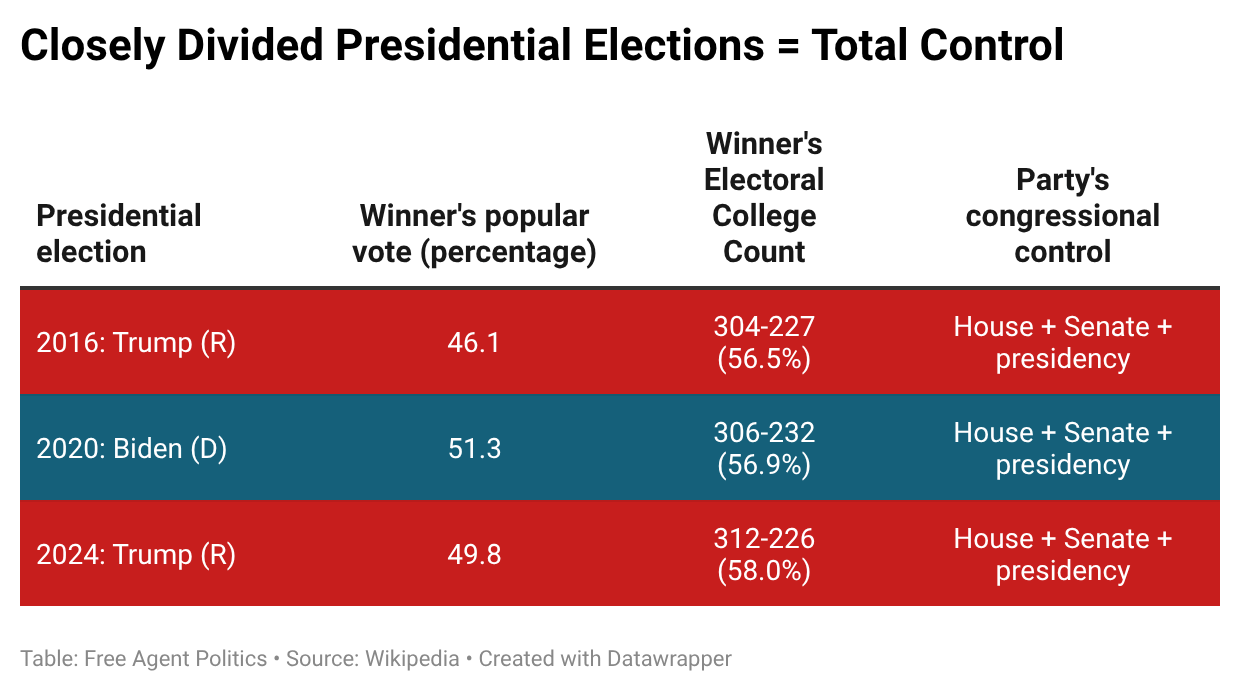
So, effectively, the three presidential elections since 2016 have each produced unified party control of government despite the “winning” party receiving very narrow margins—e.g., candidates garnering less than or barely half of the national popular vote. Conceivably, these sharp divisions could produce prudent governance and conciliatory gestures toward the opposition, actions one might expect in a reasonable political system that respects the rights and desires of the minority.
Instead, the victorious parties have treated these victories as broad mandates for pursuing major elements of their respective agendas through the budget reconciliation process, aggressive efforts to shape the federal judiciary through partisan and ideological appointments, and the use of executive actions and federal regulations to advance partisan priorities and overcome institutional obstacles. Among the signature legislative achievements of Trump’s first term was a massive tax cut plan passed solely on party lines. Among the signature legislative achievements of Biden’s term was the “Inflation Reduction Act,” a massive climate change and prescription drug measure passed with zero Republican votes. And among the signature legislative achievements so far in Trump’s second term is another massive tax cut package, the “One Big Beautiful Bill Act,” passed only with Republican votes.
Of course, there are plenty of unobjectionable bipartisan measures that pass under one-party-controlled governments with attempts by the leaders of both parties to move forward cooperatively on certain national security, public health, economic, or infrastructure issues. But on top of the major ideological priorities of Republicans and Democrats passing solely on party lines in recent years, we’ve also seen aggressive partisan efforts to alter electoral rules, manipulate congressional district boundaries through partisan gerrymandering, use executive orders to target opponents’ policy priorities, and pursue congressional investigations and judicial proceedings involving perceived political enemies and their backers.
This partisan-first approach has produced a recurring backlash: the president’s party lost control of the House in both of the first two midterms during this period. The process then repeats itself after four years as another narrowly decided election gives opponents full control of government again, highlighting what my good friend and old TLP colleague, Ruy Teixeira, and his AEI co-author, Yuval Levin, call “politics without winners”—a permanent stalemate between two essentially minority parties that cannot adjust themselves to achieve sustained majority status.
The tyranny of the tiny majority is what happens when a party tries to turn a plurality or bare majority of national support into near-uniform control of politics and policymaking.
The result is a cycle in which neither party has been able to sustain majority support from Americans for its governing agenda. Instead, they choose to exploit temporary control of government for narrow partisan power and ideological goals that alienate large portions of the country.
This is beneficial for the parties’ media operations, activist mobilization efforts, and fundraising numbers. But it is not beneficial for a nation that desperately needs stable governance, focused cooperation on America’s chief economic and security challenges, and politics that are less engulfed in partisan enmity and contempt.
The Dems are teeing up for misreading the potential 2026 wave. Hating The Evil Orange One is not an endorsement of their agenda.
The above is an excellent observation, but the situation seems likely to get worse, long before it improves. Dems will retake the House. That is not a problem. Political parties who fail to deliver, are punished in the voting booth.
The change in control, however, will likely lead to immediate and perpetual Impeachment of the President and Cabinet members. It will not matter that even if Dems retake the Senate, they will be far short of 67 votes to convict anyone, of anything. The Impeachments are very likely to drag on, until day Trump departs the WH for the last time.
More important than the Circus returning to town, will be Dems likely owing their victory to a small number of actual DSA candidates and a much larger group of DSA adjacent candidates. This group will hold the House hostage, as they attempt to accomplish the minimum. It is very probable Dems will soon make one of the most dramatic Left turns in all of US history. Anyone who thinks we could never possibly be more divided than the last decade, hasn't seen anything yet.