


In the opening weeks of Free Agent Politics, we’ve explored several factors leading an increasing number of Americans to describe themselves as independents. These include the rejection of team politics and binary thinking, the desire for alternative political choices and new electoral arrangements, overall moderation, and attitudes about incumbent governments.
An interesting paper from Alex Tolkin, a postdoctoral researcher at Duke, goes a step further to explore the exact reasons why someone who once was a Democrat or a Republican decides to switch and declare themselves an independent. Tolkin examines eight waves of NORC AmeriSpeak data from 2016 through 2022 to isolate roughly 1200 respondents who identified with either of the two major parties in an earlier wave and then switched to being an independent in a later one, and then explores a number of hypotheses about why they moved.
Tolkin’s analysis finds three intriguing explanations for why people might switch to being independent, in descending order of predictive strength: (1) “decreasing favorability towards one’s preferred party was an extremely strong predictor of switching,” (2) “decreasing favorability towards the party standard bearer strongly predicted switching,” and (3) “decreasing agreement with one’s party’s policy positions only partially predicted switching.”
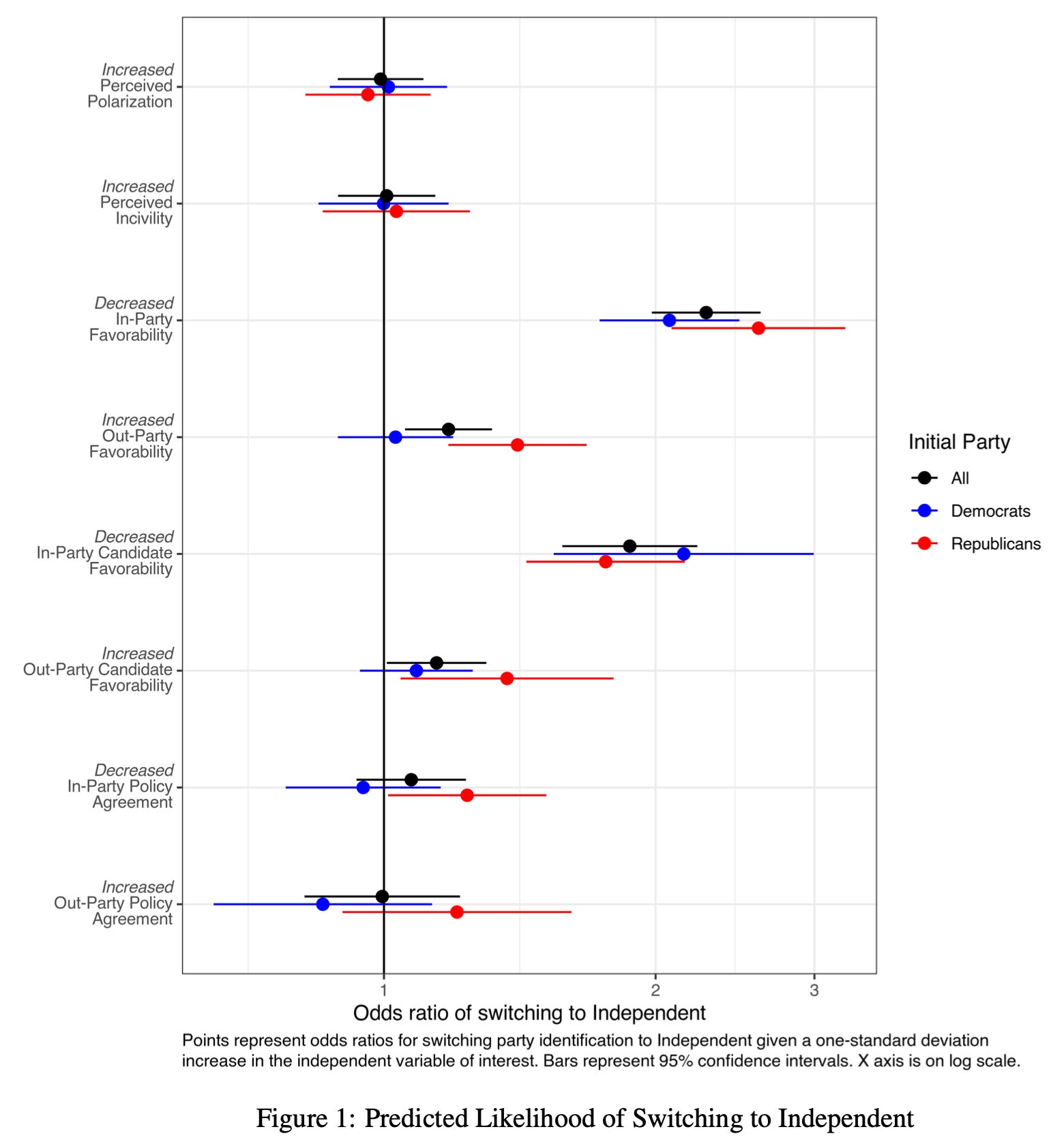
A respondent who viewed their own party less favorably by one standard deviation was more than twice as likely to switch to independent compared to one who did not change their party favorability. Likewise, one standard deviation decrease in favorability towards a person’s presidential candidate made them 1.87 times as likely to switch to independent. Increasing favorability toward a respondent’s “out party” and its candidate also had an impact, but at lower levels of importance. So, there is evidence that people might become independent because of more positive views of the other side, but the more important reason is displeasure with one’s own party and candidates. That’s what really drives people to leave their party identification behind. Issue disagreement with one’s party does lead to switching, particularly among Republicans in these data, but with much less of an impact than party and candidate favorability.
In plain English, people lose their partisan attachments because they think that their own party is bad, that their own presidential candidate is bad, and many (but not all) of the party’s positions are also bad.
It’s not difficult to see how these earlier findings from Tolkin’s research might have applied to the last presidential cycle. For starters, the two parties themselves have been in the toilet for years in terms of public favorability. Similarly, Joe Biden, Kamala Harris, and Donald Trump all received net unfavorable ratings from voters in 2024. And increasing numbers of Americans don’t trust either party’s policy agendas, while many find key aspects of each party’s respective policy portfolio particularly objectionable. The combination of these factors could be enough to drive one-time partisans to declare their independence.
“I didn’t leave my party, my party left me,” makes a lot of sense in this context. Partisan alienation is leading more and more Americans to ditch their old party and become independent rather than take the more drastic step of switching parties altogether.
Simply put for me is I have not felt I have a party for the last decade. I'd prefer government to be moderate, stay out of people's personal lives and healthcare, protect our borders and country, make reasonable immigration policies and reasonably support citizens who are struggling with programs that actually bridge them to becoming financially independent (which can't happen when benefits are yanked month to month). Both parties, especially at the national level, keep supporting the most extreme ideas, dumbest candidates, keeping Congress deadlocked, and police my thoughts, words and body one way or another. Drink my kool-aid or else. Any politician who dares be moderate or compromise is immediately stamped out by their own party. And meanwhile, the gift and corruption and wealth building in both parties is ridiculous. And I'm absolutely sick of the hypocrisy of politicians. I keep thinking a strong, moderate party could rise up, but now I think we should eliminate parties completely and demand each candidate tell us what they really stand for and cut all the money and influence coming from all the wealthy PACS, big business and billionaires. It's a sh*t show.
I think the data tells us something important. It shows that people who become less favorable toward their own party, its standard bearer, or some of its policies are more likely to shift toward independent identification. At this point, I’m less interested in trying to determine which of those is most important than in the question the data does not answer: why did those evaluations change in the first place?
There seem to be at least three plausible explanations. The parties themselves may have changed. The voters may have changed as their education, age, economic circumstances, and other characteristics changed. And the information environment may have changed what people know or perceive about the parties. Looking at some of what has been presented in The Long View, there seems to be evidence that all three kinds of change have been occurring. What we do not know is which of them is most important, or perhaps more importantly, how they are interacting