

It’s clear that many Americans no longer trust either Democrats or Republicans with unified control of the federal government for very long.
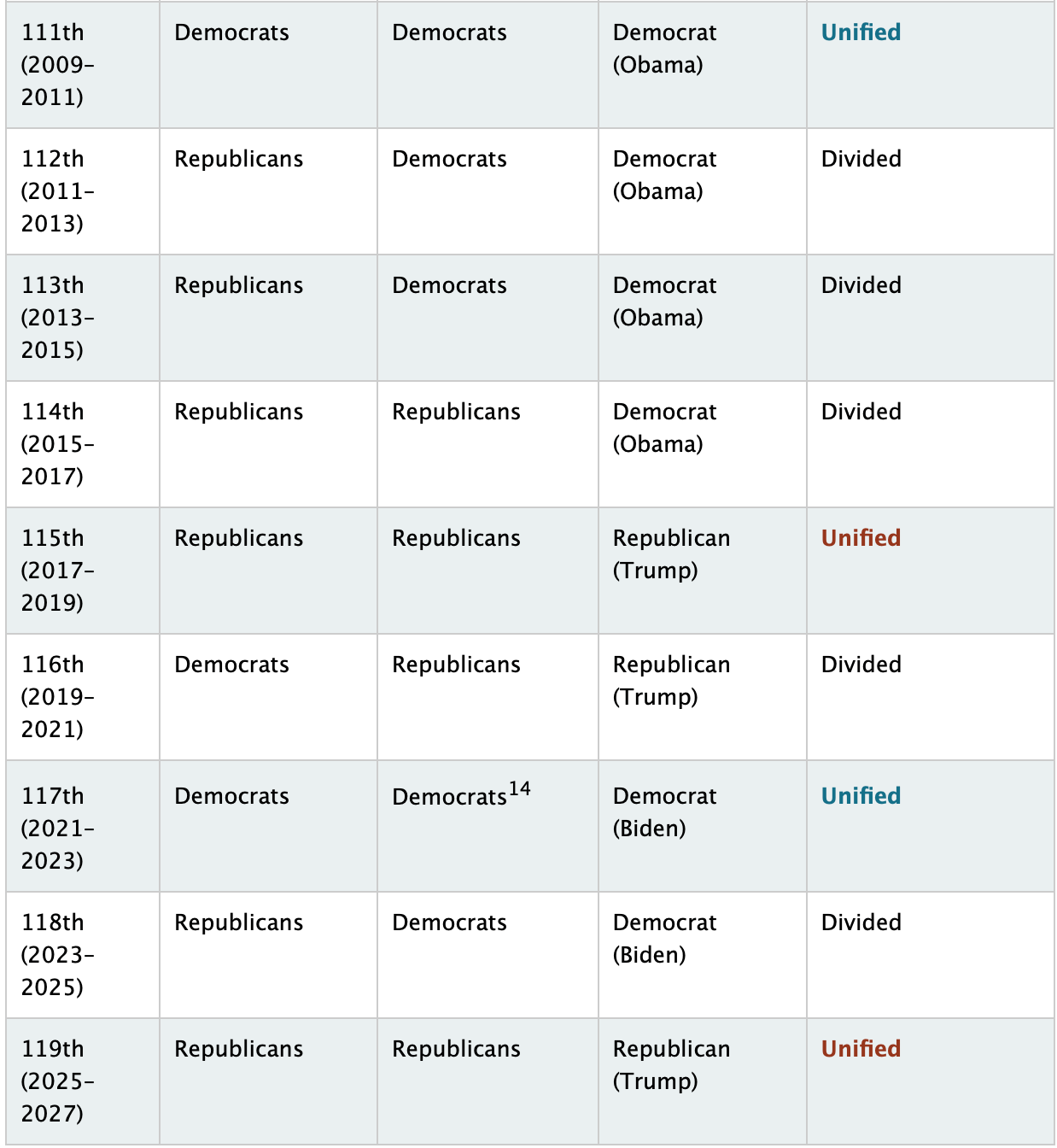
Look at the past 18 years of elections. Voters delivered unified control (House, Senate, presidency) to Barack Obama after his election in 2008, only to break back to a Republican-controlled House by the next midterm. Republican House control stayed in place for the remainder of Obama’s presidency, along with the party regaining the Senate after the 2014 election. Donald Trump started his first term in 2017 with unified control of government, only to lose the House two years later, followed by the presidency and Senate in 2020. Joe Biden then strode into office in 2021 with unified control and—once again—watched his party lose the House in 2022 and then lose full control of the entire government to Trump and Republicans in 2024.
If pre-election polls this year are even remotely on target, Americans this Election Day will vote for yet another period of divided government starting in 2027, perhaps with Democratic majorities in both the House and Senate.
It should be obvious by now that large numbers of Americans—including millions of independent voters—do not like the political rule and policy choices of the two parties. Neither party’s leaders and their agendas have a firm hold on the imaginations and votes of the people. If they did, a critical mass of voters would support their ongoing projects and give them a chance to enact economic and social policies over time.
But Americans are practically screaming to the two parties that they do not support most of the choices they make and are deeply displeased with the state of the economy, their own personal financial standing, and the cultural positions that define perpetual warfare between Democrats and Republicans. Independent voters, in particular, do not believe the two main parties are capable of looking beyond their partisan power plays to focus on the collective needs of the nation as a whole.
Prices remain high. Health care is outrageously expensive. Debt is skyrocketing. Social Security faces insolvency. Wars don’t seem to end. Nothing seems to be done about it.
So rather than reward two increasingly broken political entities with more power and larger majorities, Americans would rather gum up the works with divided government. Voters do not necessarily want gridlock. Instead, they simply do not trust either party enough to give it a free hand.
“Do no harm” is seemingly better to voters than “all harm, all the time.”
Republicans are on track to get smacked with this lesson today. But both Democrats and Republicans should expect deep skepticism about their respective political projects heading into the next presidential election. Neither party seems interested in reforming itself or its agenda to build the durable support necessary to govern the country effectively over time.
Until the two parties adapt to meet most Americans’ demands and represent their values better, voters will continue to resist granting either side unified control of government beyond one electoral cycle.
Years ago I met a guy who always voted against the incumbent. That was his entire political strategy.
It seem simplistic and foolish to me then. Today, I'm not so sure.
What we need is more political parties and in fact a bit more than that. It need to be more of a possibility for a new political party to join the competition and have an opportunity to inject new ideas. Instead we have only two parties, with both of those parties being dependent on big money donations for getting re-elected.
Competition is a good thing. It would be a good thing for our government just as it would be a good thing for our economy. But big money brings great power with great influence over both the economy and government. What we need now are some big ideas that could shift the balance so that ordinary people have more of a say in government and in the economy.